
Monday, September 21, 2009


Thursday, July 16, 2009
Ron Paul, “Health Care Is Not A Right”
Yahoo Finance reporter Aaron Task interviewed Congressman and Doctor Ron Paul recently, and the statements he made were as straight forward and logical as any I've heard on the health care “debate” going on in Washington.
He said health care is “not a right,” and that the current administration is going through a series of very large spend, spend, spend procedures to “give” individuals everything they need. Obama and his benevolent helpers are paving the road to economic Armageddon with their good intentions. No good deed goes unpunished is a phrase that comes to mind. We should also ask seriously where the money will come from, because the good Congressman is correct.
Health care isn't a right. Nor is an education for the children you did not conceive; nor is a retirement for someone whom you don't know; nor is a home for those who lost their jobs, or spent too much of their income. It all makes us feel better to know that someone, or something, has our backs if we fall down. But allying our feelings through the public redistribution of privately earned wealth simply isn't a “right.” It's not, because no one has the right to another person's money, no matter how much better it makes them feel.
I personally find it ironic to no end that the first black President in The United States is a man who's pushing so hard to create economic slaves. But the irony doesn't end there.
Government is growing by leaps and bounds, while the income of most Americans is plunging – which is exactly why the deficit is soaring. But ultimately the big problem we should all look out for in health care, at least in the near future, is the same problem we've seen the administration choke over in their predictions of what amount of money is sufficient to make up a “stimulus package.” In short, they don't know. As I mentioned in my last post, there's a litany of problems and interpretations that the stimulus package is dragging along with it. The most disheartening of which is that the Obama administration is avoiding accountability by constantly shifting their baseline in order to cover the incorrect estimates they made regarding the state of the economy. It's hard to know what steps to take, if the floor under your feet is constantly moving.
I've listed here some other small details that I think the administration is conveniently overlooking for the sake of expediency and feeling good. When these very real problems come to light, we can expect more shifting baselines, and more calls for expansion of the soon-to-be health care nightmare.
1. The government has underestimated the total number of sick persons in the U.S.
2. They have underestimated the number of individuals who right now do no seek medical attention because of its cost.
3. They have underestimated the initial cost of the program, in the same way that England, France, Canada and many other single-payer countries, now looking to divest themselves of their health care systems, underestimated their initial costs.
4. They are overlooking the obvious fact that many Americans left on the margin will intentionally find ways to reduce their income, if the benefits of publicly subsidized health care outweigh the benefits of keeping the extra income, and the costs of compliance with the punitive new laws.
5. Right now, the medical industry in the U.S. requires one dollar of regulatory cost for every two dollars spent. That's a rate of 50 staggering percent. It's higher than any other industry. With more government intervention, in what's already the most heavily regulated industry in the country, that ratio isn't likely to improve.
What all of this means is that health care will cost the American public far more than the original one trillion dollars estimate. And worse still, once the program is instituted, it will be impossible to extricate. This is horrible news for the people who are already suffering through the worst economic conditions in 70 years.
Eventually, I hope the American people will come to see that we don't suffer from a lack of government meddling. We don't have a lack of medical insurance. What we need is what Mr. Paul stated at the end of his conversation with Aaron Task: “I want everybody to have maximum care at the best price. And that's why I want the government out of it completely.”
He said health care is “not a right,” and that the current administration is going through a series of very large spend, spend, spend procedures to “give” individuals everything they need. Obama and his benevolent helpers are paving the road to economic Armageddon with their good intentions. No good deed goes unpunished is a phrase that comes to mind. We should also ask seriously where the money will come from, because the good Congressman is correct.
Health care isn't a right. Nor is an education for the children you did not conceive; nor is a retirement for someone whom you don't know; nor is a home for those who lost their jobs, or spent too much of their income. It all makes us feel better to know that someone, or something, has our backs if we fall down. But allying our feelings through the public redistribution of privately earned wealth simply isn't a “right.” It's not, because no one has the right to another person's money, no matter how much better it makes them feel.
I personally find it ironic to no end that the first black President in The United States is a man who's pushing so hard to create economic slaves. But the irony doesn't end there.
Government is growing by leaps and bounds, while the income of most Americans is plunging – which is exactly why the deficit is soaring. But ultimately the big problem we should all look out for in health care, at least in the near future, is the same problem we've seen the administration choke over in their predictions of what amount of money is sufficient to make up a “stimulus package.” In short, they don't know. As I mentioned in my last post, there's a litany of problems and interpretations that the stimulus package is dragging along with it. The most disheartening of which is that the Obama administration is avoiding accountability by constantly shifting their baseline in order to cover the incorrect estimates they made regarding the state of the economy. It's hard to know what steps to take, if the floor under your feet is constantly moving.
I've listed here some other small details that I think the administration is conveniently overlooking for the sake of expediency and feeling good. When these very real problems come to light, we can expect more shifting baselines, and more calls for expansion of the soon-to-be health care nightmare.
1. The government has underestimated the total number of sick persons in the U.S.
2. They have underestimated the number of individuals who right now do no seek medical attention because of its cost.
3. They have underestimated the initial cost of the program, in the same way that England, France, Canada and many other single-payer countries, now looking to divest themselves of their health care systems, underestimated their initial costs.
4. They are overlooking the obvious fact that many Americans left on the margin will intentionally find ways to reduce their income, if the benefits of publicly subsidized health care outweigh the benefits of keeping the extra income, and the costs of compliance with the punitive new laws.
5. Right now, the medical industry in the U.S. requires one dollar of regulatory cost for every two dollars spent. That's a rate of 50 staggering percent. It's higher than any other industry. With more government intervention, in what's already the most heavily regulated industry in the country, that ratio isn't likely to improve.
What all of this means is that health care will cost the American public far more than the original one trillion dollars estimate. And worse still, once the program is instituted, it will be impossible to extricate. This is horrible news for the people who are already suffering through the worst economic conditions in 70 years.
Eventually, I hope the American people will come to see that we don't suffer from a lack of government meddling. We don't have a lack of medical insurance. What we need is what Mr. Paul stated at the end of his conversation with Aaron Task: “I want everybody to have maximum care at the best price. And that's why I want the government out of it completely.”
Wednesday, July 15, 2009
Stimulating News
Over the last couple of days there's been some interesting cometary from Washington politicians regarding the stimulus package, it's effects so far and the plans for its future. Like many of you, I've been keeping track of some of the goings on, and I've found the latest statements to be noteworthy.
On Sunday, President Obama took an unusual step by placing an op ed in The Washington Post. He's on the defensive, after being criticized by conservatives for taking too much tax money, taking too much time to get the stimulus program (a.k.a. “The American Recovery and Reinvestment Act”) under way and that the program, which was meant to “stop the bleeding,” simply isn't working. All of this seems to be true, especially when you consider the “metric” the administration is using as their point of reference.
On Sunday, President Obama took an unusual step by placing an op ed in The Washington Post. He's on the defensive, after being criticized by conservatives for taking too much tax money, taking too much time to get the stimulus program (a.k.a. “The American Recovery and Reinvestment Act”) under way and that the program, which was meant to “stop the bleeding,” simply isn't working. All of this seems to be true, especially when you consider the “metric” the administration is using as their point of reference.
I need to point out that it's pretty tough to have a consistent baseline (metric) of how well you're performing when your point of reference is constantly shifting. At one time in my life, I wished for teachers who would teach the way the Obama administration is administering.
But apparent present-day failures, massive historical lessons showing the same kinds of failures, shifting baselines, constant criticism and an otherwise lack of economic response (unemployment was up again in June) haven't changed the minds of the politicians who can't seem to see what's blatantly obvious to the rest of us. The bleeding hasn't stopped.
But let it not be said that politicians can't take advantage of a perfectly good tragedy. What would you and I do if confronted by massive debt, an uncertain job future and the threat of inflation? Well, we would spend twice as much – clearly. In what sounds like the next step in the performance of The American Recovery and Reinvestment Act, Vice President Joe Biden, who's lately become somewhat of a motormouth, stated that the administration “misread” the economy, leading to new and widespread speculation about the idea of a “...Reinvestment Act” part deux.
If part one has cost us 787 billion official dollars, trillions in printed reserves, a government controlling interest in the automotive and financial sectors and a plunging value for the dollar worldwide, among other things, we can only speculate how much the next installment in this program will distort the American economy. My guess is a new belief in something that I've resisted for several years now – hyper-inflation. I'm remembering my post “Mark's Top 30 Watch List For Economic Armageddon.” Unfortunately, there are only two steps left to take on that list, and Murphy's Law dictates that they're well on their way.
We can only hope and pray that I'm wrong. Even I hope I'm wrong. But one thing is certain, the stimulus package has become the 800 pound gorilla in the room. It's massive, and impossible to ignore or avoid, no matter where you're standing.
So the news over the last several days has been interesting. Our leadership is providing us with little glimpses of insight into how they feel about the status of their economic policies, and where those policies might be headed. Unfortunately, it appears as though the worst of the storm is still directly ahead of us.
Friday, July 10, 2009
Happy Birthday Nikola Tesla
 True genius never dies. Nor does it ever fade away. Those who inspire us and change the world for the better, even if it's just through simple works of art, always leave us with something to contemplate for centuries. Leonardo DaVinci, Michael Angelo, Goethe - to this day their works strike awe into our hearts and minds. They make us stop and think, and reflect not only on their bodies of work, but also on the nature of intelligence and what immense things a single human being is capable of.
Tesla and his accomplishments, though they may be more practical and less artistic, have made him in my mind the single greatest inventor in history. I honestly cannot imagine what today's world be like if we didn't have him in our past.
He was the first person to envision a spinning electromagnetic field, and then went on to invent the first brushless electric motor. And he did it despite being told by his engineering professor that such a motor was “impossible.” He later continued his inventing, and produced the first hydro-electric power plant, which is still located in Niagara Falls – and by all accounts, could still produce energy if called upon. He invented current amplifiers, fluorescent light bulbs, neon lighting, remote control, the first robotics, the first air hammer, remote power sourcing (which we're only now beginning to understand), and so many other things that his list of patents numbers over 400 items.
As I mentioned, his intellectual pursuits may have been more practical than artistic, but they're no less inspirational to anyone who wants to pay attention. We still use them every, single day. All of us.
I like to say that people like him should live for at least two hundred years. But then, in a way, he's still with us. So thank you, Niko. And happy birthday. You made the world a much better place. And we remember you.
Wednesday, July 8, 2009
Everything Is Under Control
And I do mean everything. In this story from the Associated Press, writers Charles Babington and Emma Vandor detail many of the subjects that were discussed at the recent G-8 summit in L'AQUILA, Italy. I would like to say that I'm surprised by the subject matter, and by the obvious control-oriented conceit of all the world-renown politicians involved. But I'm not. On the leaders' plate of subjects are the “unprecedented and concerted action” of government spending programs, the security of Iran and North Korea, the rise in global temperatures, the Kyoto Protocol, the plight of developing nations, an “enhanced global framework for financial regulation,” executive pay, the definition of “risk capital” and volatility in oil prices, among some other lofty subjects. After reading the article, I had to wonder to myself if there isn't anything that our government overlords think they can't control.
Totally irresponsible government spending? No problem. We'll just reel it in at some future time... and we'll decide on that later. Iranian and North Korean dictators who refuse to be contained or pacified in any way? We can take care of that also. At some future time. Global warming concerns us greatly, even though we ultimately don't know what causes it. We'll talk about it again – eventually. Oil price volatility? Again, no problem. We'll just make the Saudis an offer they can't refuse – Godfather style. Who else could they possibly sell to? When all of these are met, we'll then turn ourselves to managing risk and executive pay for the masses, because we believe they take on too much risk, and we think some of them get paid too much for doing it.
I have to stop and ask a question here. When and where, exactly, does all of this ridiculousness stop? In the words of Ayn Rand, “The creator's concern is the conquest of nature. The parasite's concern is the conquest of men.”
So good luck parasites. I'm not yet forty years old, and I fully understood years ago that one thing that cannot be contained is human nature.
Totally irresponsible government spending? No problem. We'll just reel it in at some future time... and we'll decide on that later. Iranian and North Korean dictators who refuse to be contained or pacified in any way? We can take care of that also. At some future time. Global warming concerns us greatly, even though we ultimately don't know what causes it. We'll talk about it again – eventually. Oil price volatility? Again, no problem. We'll just make the Saudis an offer they can't refuse – Godfather style. Who else could they possibly sell to? When all of these are met, we'll then turn ourselves to managing risk and executive pay for the masses, because we believe they take on too much risk, and we think some of them get paid too much for doing it.
I have to stop and ask a question here. When and where, exactly, does all of this ridiculousness stop? In the words of Ayn Rand, “The creator's concern is the conquest of nature. The parasite's concern is the conquest of men.”
So good luck parasites. I'm not yet forty years old, and I fully understood years ago that one thing that cannot be contained is human nature.
Monday, July 6, 2009
They Only Cost You 874 Dollars Each
Headlines, headlines. Lots and lots of headlines. But one in particular stands out from all of the others. And, no, it isn't about Michael Jackson.
Today US bankruptcy judge Robert Gerber gave the green light to allow GM to declare bankruptcy, leaving bondholders, consumers, consumer groups and unions in the financial dust. The move was seen months ago by anyone who isn't a statist-minded Obama maniac, or by anyone who still has more than half a brain.
Luckily for the taxpayer, the automotive industry bailout is only costing every man, woman and child in America a measly $874.00. But unfortunately for the American taxpayer, the Obamas and their crew have bigger plans in store. The insurance industry is still struggling. Healthcare “reform” should only cost about 1.7 trillion dollars. Municipalities are coming up short all across America. And the “stimulus package,” which clearly is nothing of the sort, is in what appears to be just its first installment.
Now is when we should all be afraid. Very, very afraid. They're coming for your paychecks, people. And there's nothing you can do about it.
Friday, July 3, 2009
Neat Videos To Share
Over the last several days I've been watching some videos I think are neat, so I thought I would share them.
Here's Jason Mraz doing his now famous "I'm yours." I love this tune.
Here's Christine Gambito doing a cover of the same tune. I don't know why I like it so much. I guess because Christine is a comedienne whom I like, and to see her doing something really sweet like this makes the vid fun for me.
Here's Kevin Skinner. If you don't know who he is, it's because you missed "America's Got Talent" earlier this week. He was fantastic. Since then I've found myself watching this video over and over and thinking "you just can't fake that kind of soulfulness." If you're already familiar with Jason Mraz and don't care to see the vid's above, really, you should check out this one.
Here's Jason Mraz doing his now famous "I'm yours." I love this tune.
Here's Christine Gambito doing a cover of the same tune. I don't know why I like it so much. I guess because Christine is a comedienne whom I like, and to see her doing something really sweet like this makes the vid fun for me.
Here's Kevin Skinner. If you don't know who he is, it's because you missed "America's Got Talent" earlier this week. He was fantastic. Since then I've found myself watching this video over and over and thinking "you just can't fake that kind of soulfulness." If you're already familiar with Jason Mraz and don't care to see the vid's above, really, you should check out this one.
Friday, June 26, 2009
Equilibrium vs. Intervention
The Euro surged Wednesday against the Swiss Franc, in what appears to be a large currency sale by the Swiss National Bank.
In the opening minutes of the U.S. market, the Euro jumped an incredible .0369 Euros, the same kind of move that has been seen twice in the last quarter.
Though the SNB would not confirm or deny a large sale of Francs, national bank officials have stated in the past that intervention was on the table in an effort to stem deflation against the Euro.
The European Union remains Switzerland's largest trading partner, and a substantial devaluation of the the Franc could harm tremendously the Swiss economy.
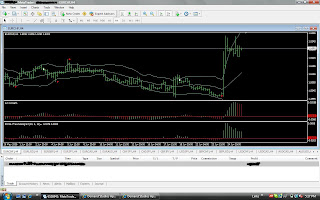
The banking sector officials may not want to confirm or deny their money manipulation techniques, but the charts speak for themselves.
Here is a four hour chart from the FOREX trading platform MetaTrader. See if you can spot the intervention.
In the opening minutes of the U.S. market, the Euro jumped an incredible .0369 Euros, the same kind of move that has been seen twice in the last quarter.
Though the SNB would not confirm or deny a large sale of Francs, national bank officials have stated in the past that intervention was on the table in an effort to stem deflation against the Euro.
The European Union remains Switzerland's largest trading partner, and a substantial devaluation of the the Franc could harm tremendously the Swiss economy.

The banking sector officials may not want to confirm or deny their money manipulation techniques, but the charts speak for themselves.
Here is a four hour chart from the FOREX trading platform MetaTrader. See if you can spot the intervention.
Thursday, June 25, 2009
Financials AP Style
Dow, S&P Take a Breath
The Dow and S&P were up Thursday, turning around a three-day decline.
Positive new information on the job market and manufacturing fueled the bounce.
After recovering from a 12-year low in March, the S&P 500 has slowed, as private investors and institutions reassess economic data. The turn offers a flicker of hope and optimism for recovery, but analysts remain cautious, saying significant improvement is still needed before projections change.
Financials supported the small rally.
Discover Financial Services rose 4 percent. Lincoln National gained 6.9 percent. And the S&P Financial Index gained 2.5 percent.
"The data supports the case of those looking for the bottom of the economy in this quarter," said Jim Awad, managing director at Zephyr Management in New York.
On the positive side, government data shows that the number of workers filing new claims for unemployment benefits rose last week, but the number of people actually collecting benefits had its biggest decline since November 2001.
Trading volume remained light on the NYSE, with about 1 billion shares exchanging hands, while the Nasdaq also stayed below last year's daily average.
Thursday, June 18, 2009
Macro Economics AP Style
Today's Economy Worse Than 1929
The current rate of decline in world economies is actually worse than the great depression, according to professors of economics Berry Eichengreen, of U.C. Berkley, and Kevin H. O'Rourke, of Trinity College, Dublin.
In a series of charts and descriptions posted online by voxeu.org, the two economists take stock of all the major economies in the world, rather than isolating the troubled U.S. economy, since the last great depression was also an international phenomenon, not just a problem specific to the United States.
They're calling the large market corrections presently taking place around the world a “depression event” that is just beginning its earliest stages.
Their charts largely show more dramatic stages of decline than in 1929 by plotting large categories such as world output, world trade, world stock markets and industrial output.
All charts but three, including those for Poland, the United States and world money supply, show that economic conditions today are actually worse than the 1929 depression.
Sunday, May 24, 2009
A Good Answer To An Honest Question
I always have a nagging question in my mind. “Why?” It never goes away. It plays in my head like a reel-to-reel tape with no end. I think it stays with me because life seems to throw at us so many questions, and so few answers, though I do come up with a doosie once in awhile – like the meaning of life (If you actually want the answer to that one, let me know. It will be a long post). So it's nice to see a real answer to a difficult question pop through all the unknowns mire, and give me (us) some true understanding. Believe it or not, I'm talking about a post that Penn Jillette left on Glenn Beck's website. He explains why he became a libertarian. And he makes a lot of sense – especially at the end. It's not that I care that Penn Jillette in particular is a libertarian, but he does answer “why” some people decide to do what they do, or believe what they believe. I'm just happy to see someone who agrees with me about the use of force and coercion, something I write a lot about, and he makes plenty of logical sense. So I can chalk up one article that has answered my nagging question – once. Did you hear my sigh of relief?
Subscribe to:
Posts (Atom)